Tallinn's Old Town in winter: a slow walking route
Explore the medieval streets of Tallinn Old Town through a measured winter route, taking in defensive towers, quiet viewpoints, and seasonal market squares.
Starting at the eastern gates
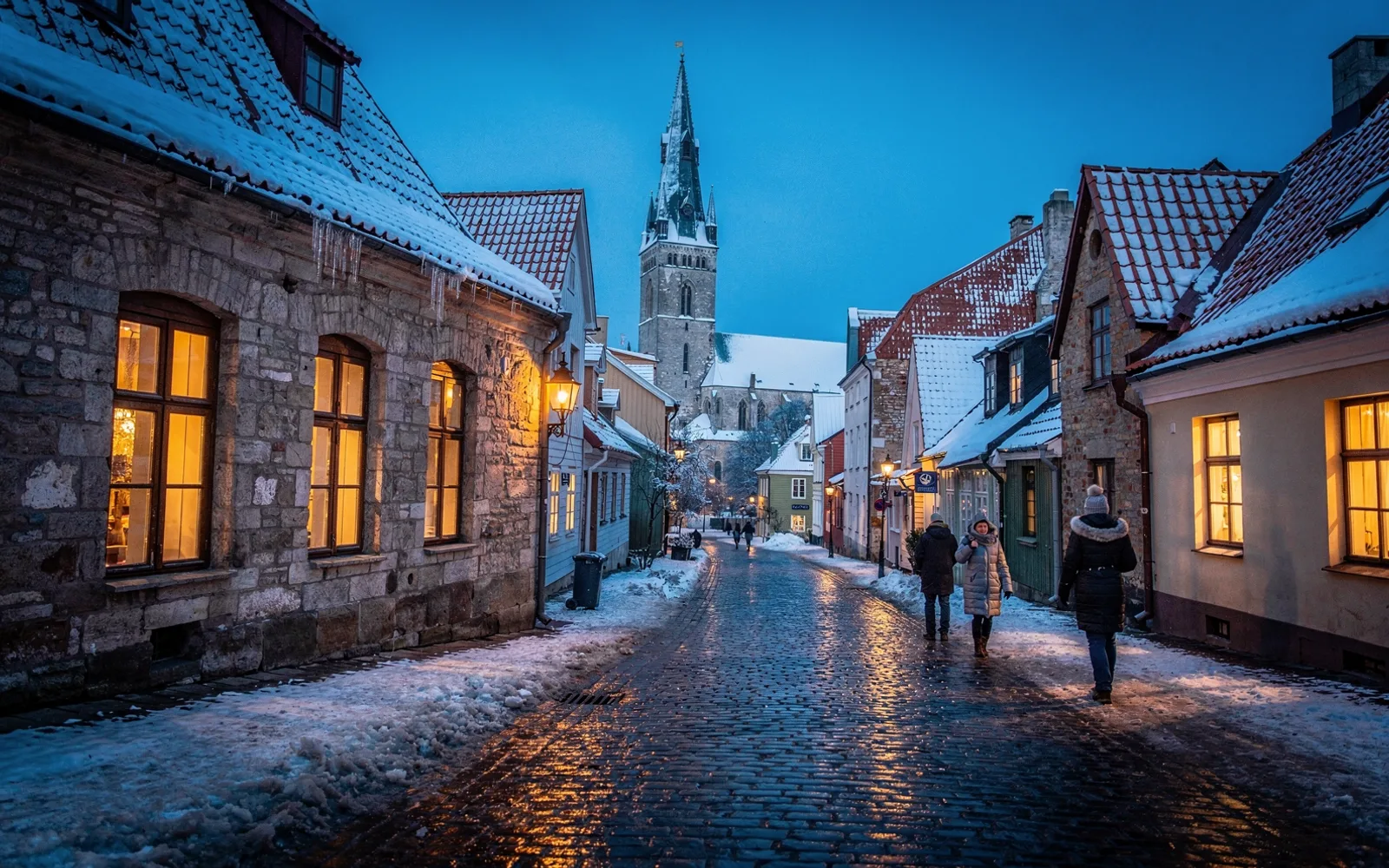
A winter walk through Tallinn Old Town begins naturally at the twin stone towers of Viru Gate. These ancient structures once formed part of a comprehensive defensive network, offering an entrance into one of northern Europe's best preserved urban settlements from the Middle Ages. In 1997, the historic center gained recognition as a UNESCO World Heritage site, protected for its intact medieval street plan, original building plots, and extensive fortifications.
During December, daylight in Estonia is brief, often lasting only around 6 hours between sunrise and mid-afternoon. This seasonal rhythm gives winter strolls a quiet character, as the low sun casts long shadows over limestone walls and snow-covered rooftops before lanterns illuminate the stone passages. Entering through the gate, visitors leave modern traffic behind and step onto uneven cobblestones that encourage an unhurried pace.
Across the central market square
Following Viru street westward leads directly toward Town Hall Square, the enduring focal point of the lower town. Dominating the open space is the Gothic Town Hall, an impressive stone landmark completed in the early fifteenth century with tall arched windows and a slender spire. For centuries, this broad plaza functioned as a thriving marketplace, meeting place, and administrative heart for Baltic maritime merchants.
In December, the square transforms to host the annual Christmas market, filling the open area with wooden stalls and warm seasonal lighting. Visitors can find traditional woolen knitwear, wooden handicrafts, and warm drinks beneath the snow-dusted facade of the medieval hall. Even as twilight gathers early in the afternoon, the festive market provides a cheerful stopping point along the walking route, offering fragrant steam and gentle activity in the brisk air.
Ascending to the heights of Toompea
From the square, the walk continues toward the limestone bluff of Toompea along Pikk jalg, or Long Leg street. This gently rising road has carried travelers between the lower merchant town and the upper hill since the fourteenth century, framed by protective walls and an arched gate tower at its base. The slow climb provides changing angles of nearby church steeples, timber doorways, and thick masonry built directly into the bedrock.
Once atop the upper plateau, the route branches out toward two renowned viewpoints: the Kohtuotsa and Patkuli viewing platforms. Kohtuotsa offers an expansive panorama eastward across the lower town, where red-tiled roofs, medieval towers, and slender spires sit clustered together. A short walk along the northern ridge leads to Patkuli platform, where visitors look down upon the defensive wall, its semicircular towers, and the frosty parklands spread out below the hill's sheer cliff edge.
Descending the narrow stairs
After taking in the winter views from the heights, the return journey leads down through Lühike jalg, or Short Leg street. Unlike the broad carriage ramp of Pikk jalg, this route consists of a steep pedestrian passage fitted with stone steps, iron handrails, and a heavy wooden doorway that was historically locked each night to separate the upper and lower communities.
The narrow stairway descends between tall medieval walls that feel especially quiet and atmospheric on cold afternoons. Footsteps echo softly against the frosted stones as the path returns visitors to the sheltered alleys of the lower town, concluding a gentle circuit through centuries of Baltic architectural heritage. The entire walk can be enjoyed in a few relaxed hours, leaving ample time to admire the craftsmanship of ancient masons before night settles completely over the city.
Spotted an error? Write to newsroom@nordexanews.com. Corrections are noted at the end of the article. See our editorial standards.