The six-wheeled robots on Tallinn's sidewalks
Designed to share pedestrian sidewalks at a calm walking pace, small autonomous delivery robots engineered in Tallinn are reshaping local neighborhood deliveries across multiple countries.
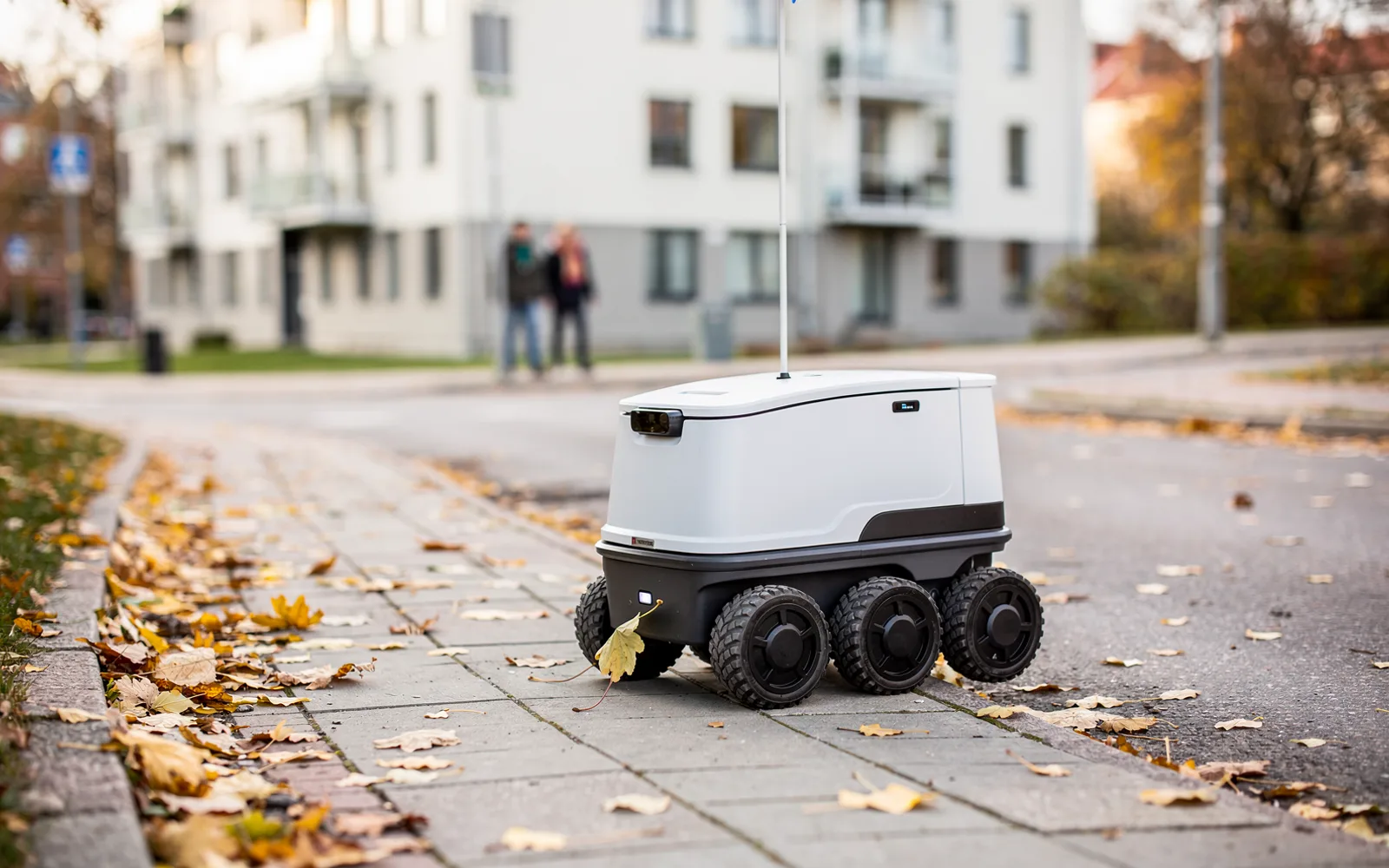
A quiet presence on city sidewalks
Pedestrians walking along the residential avenues and quiet suburbs of Tallinn frequently share the pavement with low, rectangular machines rolling on six wheels. These compact white delivery devices navigate around lampposts, cross signalized intersections, and wait patiently behind people at zebra crossings. Over the past decade, their presence has transformed from an unusual curiosity into a standard element of the local streetscape. Many residents no longer pause to look, treating the rolling couriers with the same casual familiarity as a passing bicycle.
Rather than sharing lanes with cars or cyclists, these autonomous devices operate strictly on pedestrian walkways and multi-use paths. They move forward at a gentle walking pace, keeping to a speed that matches the natural tempo of foot traffic. Their electric drivetrains generate almost no noise, enabling them to travel past residential houses, schools, and bus stops without adding sound to the neighborhood environment.
The visual design emphasizes simplicity and safety, featuring soft rounded corners and a tall safety flag fitted with an orange light. This flag ensures the low-profile machines remain clearly visible to drivers backing out of driveways and pedestrians turning street corners. By sticking to sidewalks and moving slowly, the machines occupy a distinct niche between traditional vehicular transport and personal foot travel.
Roots in Estonian engineering
The technology behind these machines comes from Starship Technologies, an enterprise established in 2014 by Ahti Heinla and Janus Friis. Both co-founders were previously integral members of the founding team behind Skype, which originated in Estonia and transformed global telecommunications. Drawing on their background in software architecture and peer-to-peer networks, they turned their attention toward physical automation and local logistics.
Tallinn remains the primary center for the company's research, engineering, and software development teams. The Estonian capital offers an ideal testing environment, where software engineers and roboticists can deploy physical prototypes directly into varied real-world conditions. Sidewalks in the region feature diverse paving materials, historic cobblestones, winter snow, and changing seasonal light levels, providing rigorous parameters for field testing.
Developing hardware alongside software allows the engineering team to iterate rapidly when addressing mechanical wear and software edge cases. Changes made to mapping routines or obstacle detection can be applied to test fleets operating within walking distance of the engineering laboratory. This close proximity between design workspaces and everyday testing grounds has helped anchor the technology firmly in the local tech ecosystem.
Sensors, software, and human oversight
Safe navigation on public walkways requires continuous spatial awareness and rapid data interpretation. Every robot is equipped with a suite of cameras, ultrasonic sensors, and specialized mapping software that construct a detailed view of the surroundings. As the machine travels, onboard computers calculate travel paths while classifying potential obstacles such as pedestrians, strollers, dogs, curbs, and low-hanging tree branches.
The navigation software relies on high-definition local maps that catalog fixed street features, including curb heights, sidewalk boundaries, and crossing locations. When changes occur, such as seasonal leaves or parked maintenance vehicles, the system adjusts its trajectory in real time to maintain a generous buffer distance. By analyzing sensor inputs continuously, the robot can identify when to yield right of way to approaching pedestrians.
Although the machines complete the vast majority of their trips autonomously, human operators remain an integral safety layer. Remote assistance centers monitor fleet operations, allowing trained staff to intervene whenever a device encounters ambiguous situations or complex construction areas. If a path is blocked or unusual roadwork confuses the onboard system, a remote operator can review camera feeds and guide the vehicle through manually.
Deliveries across campuses and neighborhoods
The operational mission of the fleet centers on the localized transport of food, restaurant orders, and everyday groceries. Users initiate orders through a dedicated mobile application, after which the robot travels to a local merchant to receive goods. Store staff place the items into an insulated, locked internal compartment that stays securely closed until the customer unlocks it using their phone upon arrival outside their home.
While early testing took place exclusively in Tallinn, the operational footprint has expanded into multiple countries across Europe and North America. University campuses have emerged as particularly successful environments for these sidewalk deliveries. Campuses typically offer broad pedestrian walkways, low motor vehicle traffic, and compact geographic layouts, creating conditions that suit autonomous sidewalk couriers exceptionally well.
In these academic and suburban settings, the robots handle routine short-distance errands that might otherwise require individual car journeys. Thousands of deliveries take place every week, blending quietly into the morning and evening routines of students and residents. What began as an experimental engineering project in Tallinn has grown into an established model for autonomous neighborhood delivery.
Spotted an error? Write to newsroom@nordexanews.com. Corrections are noted at the end of the article. See our editorial standards.