Boardwalks over the bog: a beginner's guide to Viru raba
Located in Lahemaa National Park, Viru bog offers an accessible introduction to Estonian wetlands through wooden paths, quiet morning light, and sweeping mire landscapes.
An ancient northern landscape
Raised bogs cover a large share of Estonia, forming distinctive wilderness ecosystems that have developed over thousands of years since the retreat of ancient glaciers. Among these expansive wetland environments, Viru raba in Lahemaa National Park stands out as one of the most accessible and celebrated examples in the region. The terrain consists of deep peat layers built up over millennia, supporting a delicate community of specialized plants adapted to acidic, nutrient-poor conditions.
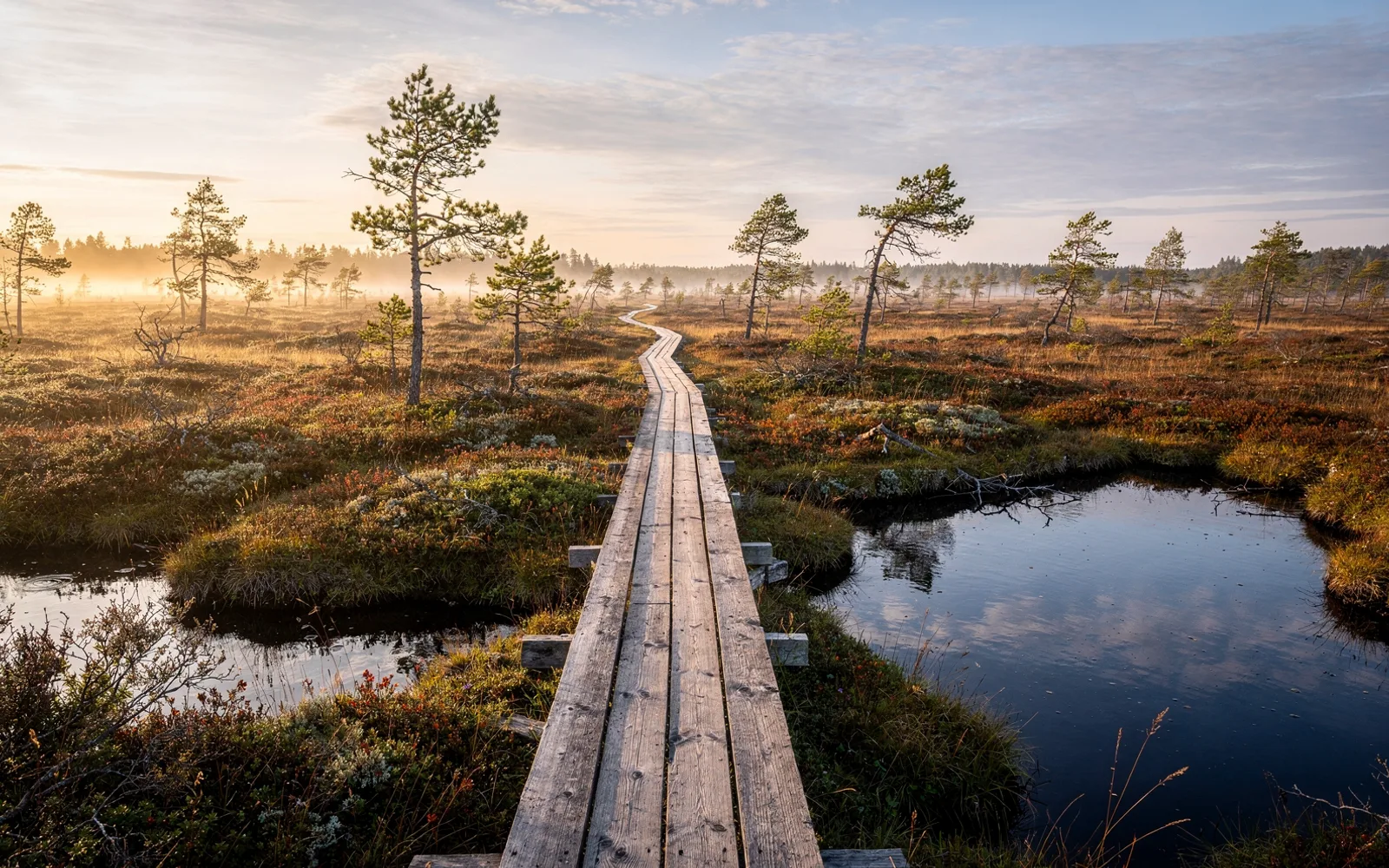
Sphagnum moss forms the living foundation of the bog, acting like an enormous natural sponge that absorbs and retains rainwater through dense cellular structures. Stunted Scots pines dot the open terrain, their growth severely restricted by the acidic and waterlogged conditions of the soil beneath. These miniature trees can be more than a century old despite standing only two or three meters tall, testifying to the harsh growing environment of the mire. Walking through this landscape provides an immediate sense of stillness and spatial openness that contrasts sharply with the surrounding pine woodlands.
The path through the wetlands
Visitors navigate this unique terrain along a well-maintained boardwalk trail that stretches for approximately 3.5 kilometers across the open mire. This wooden path allows travelers of all experience levels to venture deep into the heart of the wetland without disturbing the sensitive ecosystem or sinking into the soft ground. The route winds gently past miniature lakes and dark bog pools known locally as laukad, which reflect the sky like polished mirrors. These deep pools formed naturally over centuries as uneven peat growth trapped pockets of standing rainwater within the landscape.
Along the way, clear informational markers explain the slow formation of peat and highlight the insect-eating sundews and hardy shrubs growing beside the timber planks. Generous resting spots provide quiet spaces to sit, listen to the wind, and observe the dragonflies and shorebirds that frequent the open waters during warmer months. The boardwalk design ensures that outdoor enthusiasts can immerse themselves in the bog environment while keeping human impact confined strictly to a narrow corridor.
Perspectives from the viewing tower
A sturdy wooden viewing tower sits near the middle of the trail, offering a broad panoramic vantage point over the expansive wetland plateau. From this elevated platform, the intricate network of bog pools, ridges, and hollows becomes fully visible across the wide horizon. The visual contrast between dark water, pale green mosses, and twisted pine branches reveals the natural architecture of an undisturbed raised bog. It is an ideal position to appreciate the sheer scale of the landscape and the flat topography of northern Estonia.
While the trail remains open throughout the year, many naturalists consider the bog to be best at sunrise. Early morning mist frequently hovers over the surface of the dark pools as the first rays of sunlight filter across the landscape. The combination of crisp air, rising vapor, and golden morning light creates an ethereal atmosphere that rewards early travelers. Visiting at dawn also means a peaceful excursion before daytime visitors begin arriving on the wooden trails.
Conservation and guided exploration
Strict conservation rules require visitors to stay on the boardwalk to protect the surrounding sphagnum moss from permanent damage. The living moss carpet is exceptionally slow to recover once compressed by human footsteps, and repeated trampling can easily destroy the delicate vegetation. A single footprint can remain visible in the soft turf for years, disrupting the hydrological balance of the surrounding peat. By staying on the wooden walkway, walkers help preserve this sensitive northern habitat in its pristine natural state.
For those interested in exploring the deeper sections of the wetland beyond the wooden path, organized bog shoe walks with trained guides provide a safe and sustainable alternative. These specialized, wide-soled frames distribute a person's weight evenly across the surface of the peat, allowing movement across damp ground without sinking or tearing the plant life. Guided excursions also introduce participants to hidden corners of the mire while explaining the local ecology and wildlife habits tied to northern wetlands. Such outings offer an adventurous perspective while keeping safety and conservation at the forefront.
Spotted an error? Write to newsroom@nordexanews.com. Corrections are noted at the end of the article. See our editorial standards.