Why Estonia's song festival grounds fill up every few years
Every five years, tens of thousands of choral singers gather beneath a massive arched stage in Tallinn, continuing a musical tradition that began in the nineteenth century.
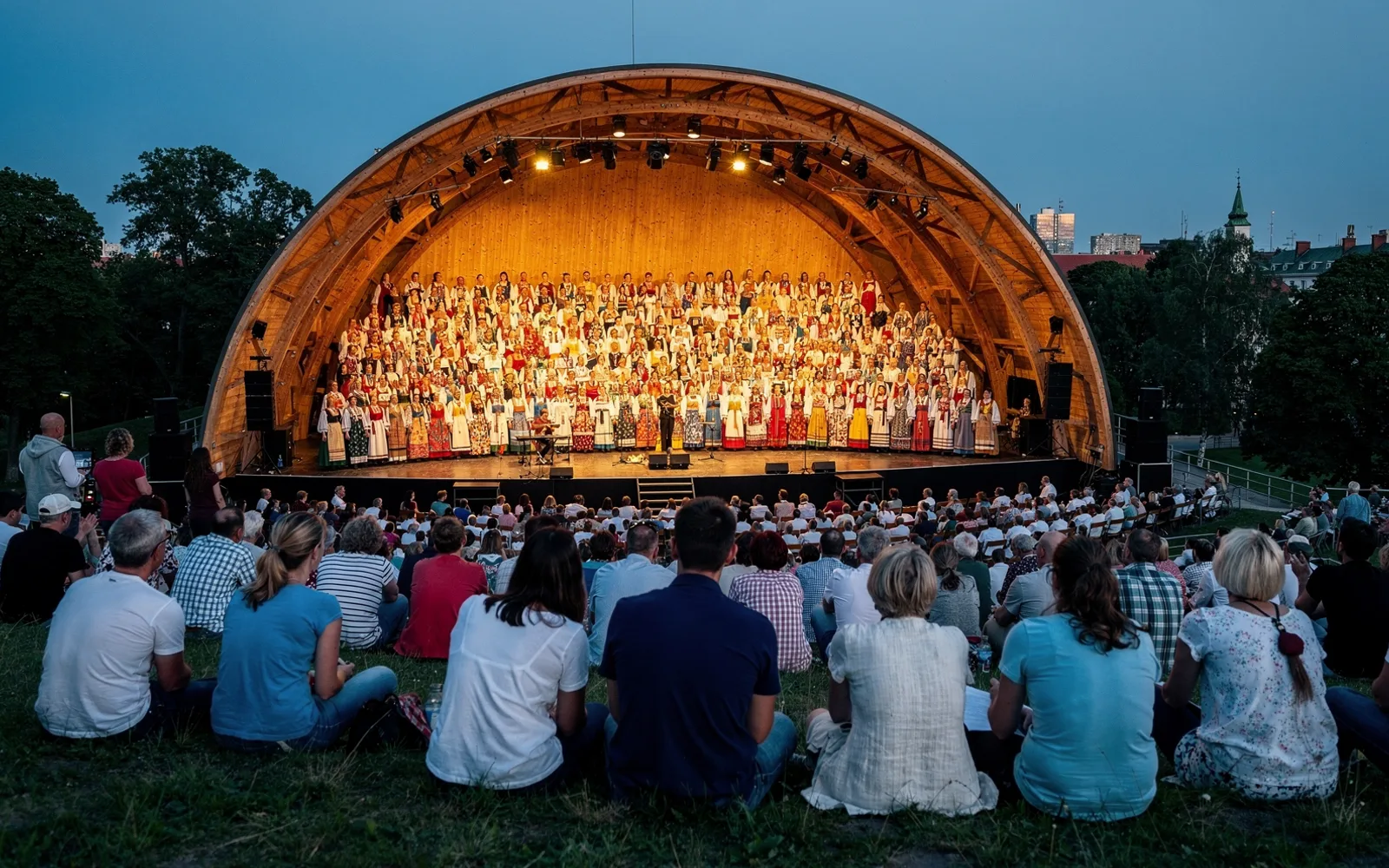
A vast gathering under the acoustic arch
On the gentle slopes overlooking Tallinn Bay, the Tallinn Song Festival Grounds form a natural amphitheater designed for acoustic clarity and monumental scale. At the center of the site stands a distinctive arched acoustic shell, engineered to reflect the voices of tens of thousands of performers outward across the hillside. Every few years, this open field transforms into one of the largest open-air musical arenas in the world as the Song and Dance Celebration, known locally as Laulu- ja Tantsupidu, brings together choral ensembles from every county. The vast lawn slopes downward toward the stage, offering unobstructed sightlines for well over one hundred thousand spectators gathered on the grass.
Spectators arrive hours before the first notes sound, spreading picnic blankets across the grass until the green hillside is completely blanketed with listeners. The visual spectacle of the event is matched by its auditory depth, as thousands of singers harmonize simultaneously without relying heavily on artificial electronic amplification. The architecture of the arched stage creates an acoustic pocket where complex multi-part choral works carry clearly to listeners resting hundreds of yards away on the upper rim of the park. Families, neighbors, and visitors sit side by side in quiet appreciation, creating an atmosphere that balances massive scale with reflective intimacy.
Roots in nineteenth-century Tartu
The tradition of uniting vocalists on a nationwide scale traces back to the summer of 1869, when the first all-Estonian song festival took place in the university town of Tartu. That initial event featured exclusively male choirs and brass bands, drawing fewer than a thousand performers and a modest audience compared to modern standards. Despite its modest beginnings, the gathering established a template for regional community organization that rapidly spread through local parish halls and cultural societies. It proved that independent choral groups from separated districts could assemble in harmony, sharing a unified repertoire of secular and traditional songs.
Over the subsequent decades, the festival expanded to welcome mixed choirs, women's choirs, and children's ensembles, necessitating ever-larger venues and formal logistical structures. The eventual move to Tallinn provided the physical space required for an expanding roster of participants and an eager public. By the middle of the twentieth century, the construction of the permanent arched stage established the physical home that continues to host the festival today. That purpose-built structure solidified the grounds as a permanent focal point for regional musical expression.
Years of quiet preparation
While the final celebration takes place over several midsummer days, the process begins years earlier in community centers, schools, and local cultural clubs. Choirs across the country receive challenging repertoires up to three years in advance, requiring regular weekly practice sessions to master intricate polyphonic arrangements. Participation is never automatic, as each ensemble must undergo rigorous regional assessment rounds to qualify for a place on the main stage. Singers memorize dozens of complex pieces in multiple parts, refining their pronunciation and dynamic balance under the guidance of dedicated community leaders.
Local conductors spend countless evenings fine-tuning pitch and rhythm, ensuring that singers from remote rural parishes match the timing and phrasing of established metropolitan choirs. This decentralized preparation builds intense camaraderie among participants of all ages, from primary school students experiencing their first festival to veteran singers with decades of stage experience. Joint rehearsals bring adjacent town choirs together in regional sports halls and auditoriums long before travel to the capital begins. By the time the choirs step onto the risers in Tallinn, they have internalized the material so thoroughly that thousands of distinct voices can blend effortlessly into a single, cohesive instrument.
International recognition and living heritage
The cultural significance of the Baltic choral tradition gained formal global recognition when UNESCO proclaimed the celebrations an intangible cultural masterpiece in 2003, followed by formal inscription on the representative list in 2008. This distinction honors the joint tradition shared across Estonia, Latvia, and Lithuania, celebrating the way communal singing preserves language, local poetry, and regional customs. The event is not treated as a static historical exhibition, but as a living art form that regularly introduces new compositions alongside beloved historic folk melodies. Each edition reflects contemporary musical craft while maintaining unbroken links to older poetic forms.
Complementing the vocal performances on the grounds, the dance celebration brings thousands of costumed performers to nearby stadiums to execute intricate geometric choreographies based on traditional folk motifs. These synchronized movements evoke traditional textile patterns, telling stories of agrarian rhythms, seasonal changes, and community life. Together, the paired song and dance festivals form an immersive cultural cycle that reinforces social bonds across generations and geographic regions. When the final choral piece concludes beneath the arch, the grounds slowly empty, and local choirs return home to begin preparing for the next edition.
Spotted an error? Write to newsroom@nordexanews.com. Corrections are noted at the end of the article. See our editorial standards.